
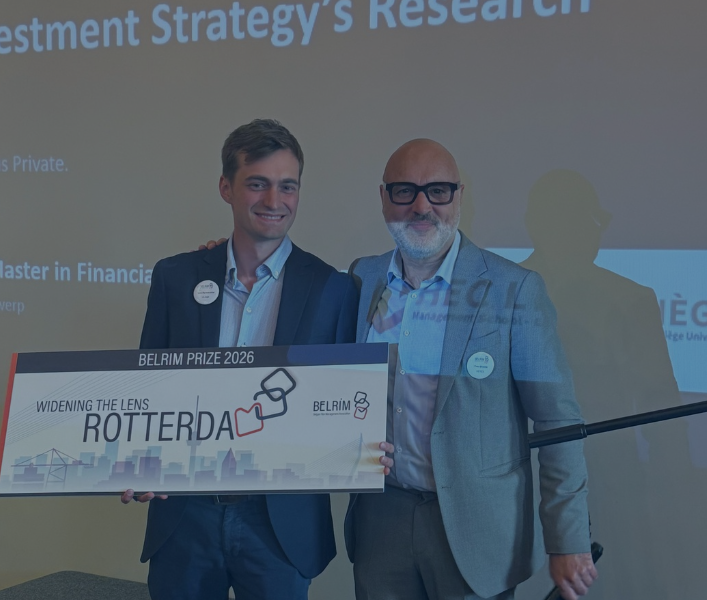
Winning the BELRIM Prize 2026 represents a major personal and professional milestone for Tom. Having completed his master’s thesis alongside his preparation for the Financial Risk Manager (FRM) Part I exam, the recognition serves as a rewarding validation of an intense academic year. Professionally, it highlights that the model he developed during his internship at Belfius Private holds distinct value beyond the bank itself, offering a strong springboard for his career in financial risk.
Tom’s passion for risk management stems from the direct influence that mathematical models have on real decisions. His appetite for practical application was confirmed during his internship at Belfius Private, where he successfully rebuilt the model setting loan-to-value ratios for loans backed by stock and ETF portfolios. Seeing that model officially adopted by the bank solidified his desire to work in the field.
The motivation behind his award-winning paper grew directly out of an operational need. While the Research Center at Belfius Investment Strategy published regular investment ideas for clients, it lacked a structured framework to measure their associated risk. Tom set out to build a quantitative framework capable of daily estimations: determining how much an investment idea portfolio could lose on a bad day and pinpointing which specific positions drove those potential losses.
To solve this problem, he designed a three-step model. First, it models the volatility of each asset to capture how calm and stressed market periods arrive in waves. Second, it models how assets move together, particularly during market downturns. Third, the system simulates thousands of possible scenarios for the following day to compute the Value at Risk (VaR) and Expected Shortfall (ES), which measures average losses on the worst days. After isolating the risk per position, he rigorously backtested the model on out-of-sample data.
While the mathematics behind such a tool are complex, Tom emphasizes that technical execution is rarely the largest hurdle for organizations. Instead, implementation challenges center around data, IT infrastructure, and human adoption. Banks operate within strict IT environments where new tools must conform to pre-existing constraints. Furthermore, overcoming skepticism toward quantitative modeling requires clear communication. Tom stresses that models are built to support decision-makers rather than replace them, noting that translating quantitative results into plain language often demands as much effort as building the model itself.
For risk managers looking to apply his key takeaways immediately, he suggests starting with a risk decomposition of their current portfolio. By examining which specific positions drive losses on the worst days, practitioners often discover that the primary drivers of risk are not necessarily the largest holdings. A crucial second step is to test how current risk metrics would have performed against historical data.
Looking toward the future, Tom views the role of the risk manager as an evolving blend of technical proficiency and strategic communication. As routine calculations become increasingly automated, the true value of a risk manager will lie in selecting appropriate models, challenging assumptions, and articulating results clearly to executive decision-makers. Both coding expertise and communication skills will be essential.
Organizations like BELRIM play a vital role in this ecosystem by bridging the gap between academia and industry. By connecting students directly with experienced risk professionals and providing visibility to practical research, events such as the BELRIM Exchange offer invaluable networking platforms for young talent entering the field.
Currently working as a freelancer in financial risk modeling, Tom plans to continue developing practical portfolio risk tools while remaining open to risk modeling and risk management roles in Belgium. On the research front, he aims to explore Extreme Value Theory to better capture the most extreme market losses.